
Amy Allender photo
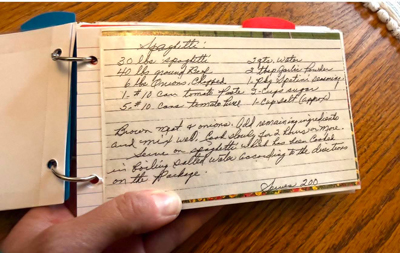
“Spaghetti.” The word is scrawled across the top of an index card in my grandmother’s loopy cursive handwriting. The recipe seems innocuous enough, until you get to the ingredient list, and the bottom which reads, “Serves 200.”
The card sits in a small binder of recipes my sister lovingly copied and organized for each of us after she passed away. There are other recipes in there, of course. But “Spaghetti for 200” remains my favorite, as well as a family joke.
Start with 30 pounds of spaghetti. Add 40 pounds of ground beef and 50 pounds of tomato puree. The part that makes it laughable is that in all of that, the recipe calls for just 2 tablespoons of garlic powder.
With ratios like that, I’m sure the garlic was completely lost. Still, it’s become a family phrase: “Don’t forget the garlic…” We say it when a situation is overwhelmingly lost and, honestly, nothing will make a difference. But you might as well try.
When things are completely awry and you’re floating in 100 pounds of sauce, your 2 tablespoons of garlic probably won’t change anything. But it’s still worth a shot, right?
My grandmother was what I grew up calling “a church lady.” Thus, “Spaghetti for 200” was in her personal repertoire. It was for fellowship dinners and fundraisers, a relic from a time when church ladies did the cooking instead of ordering pans of fried chicken or tubs of make-your-own burrito bowls.
Recently, I glimpsed the infamous recipe while searching for something else in the binder. For a moment, I was sucked back in time and space to the kitchen in the basement of Faith United Methodist Church in South Bend, Indiana. It’s been more than 20 years since I last walked into the sunny yellow space that always smelled like a mix of stale coffee, rust, and perfume. But for a moment, I could see it clearly, right down to the hand-embroidered towels.
I never understood the towels. Why take time to stitch happy cats or the days of the week onto cloth destined to be stained and ultimately destroyed? I supposed it was a church lady thing.
When I was a little older, my family began going to a church closer to our home instead of the one my grandparents attended. There, again, I encountered the towels: plain white with embroidered fruit, smiling suns, and the words “Wash and Dry.”
In college, I attended a Presbyterian neighboring my dorm. Again: the towels. After getting married and moving with the military, I encountered them in church kitchens across the country. Though I still didn’t fully understand them, there was a measure of comfort in knowing that no matter where you went, no matter how different the food or the dialect, some things remained constant. There are even a few of those towels living in the drawers at First Baptist Church right here in Minot.
As I type this, I’m sitting at my son’s Little League game, laptop open, trying to write as quickly as I can. What I’d rather be doing is working on the embroidery project tucked in my bag.
It’s a hobby I took up two years ago. The project itself doesn’t matter. In fact, I’ve got a drawer full of completed pieces with no real purpose. It’s simply something to do with my hands. Something that focuses my mind and slows spinning thoughts when I’m stressed. I’m starting to think that if I don’t really care what I embroider, I should probably start stitching something useful…like a dish towel.
Maybe after all these years, I’m finally starting to understand.
It was never really about the dish towels. And maybe it wasn’t even about making spaghetti for 200.
It’s about growing into the roles once filled by the people who came before us. Finally understanding that maybe the people who seemed to have it all together, also needed something to do with their hands to offset the stress of the day. It’s about becoming the steady presence in the room, the person who creates continuity, comfort and hospitality in a world that often feels confusing and unfamiliar. It doesn’t have to look exactly the way it did 50 years ago. Times change. Home-cooked dinners for 200 and embroidered dish towels may someday disappear entirely.
But the need behind them never will.
The small ways we carry on will be the more of nostalgic memories for those who come after us. That’s the real recipe worth passing down. And unlike the garlic powder, it never gets lost in the sauce.
Come back next week when I team up with Cornerstone Chiropractic to share things you can do now that your winter self will thank you for. For more of my writing and views on North Dakota, join me online at amyallender.com or social media @heyminot.